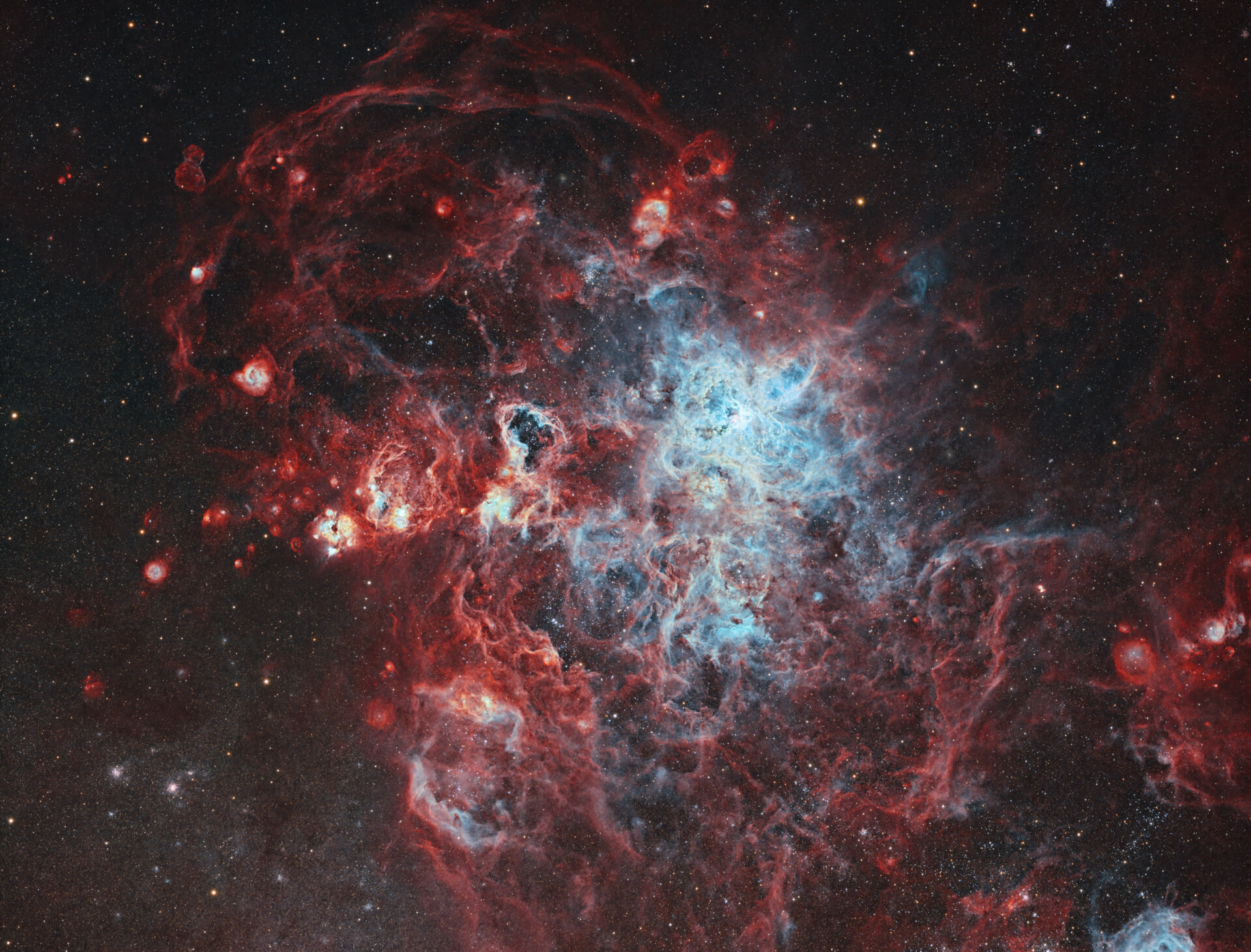
The Tarantula Nebula is undoubtedly one of the best objects in the night sky, visually, photographically, and scientifically. Situated roughly 49Kpc (160,000 Ly) from Earth, this HII region is not within our own Galaxy, but rather the Large Magellanic Cloud (LMC), a dwarf galaxy which is the closest significant neighbour to the Milky Way. It is the most active know star forming region within the local group of galaxies, and is thought to contain almost 1 million stars and protostars that have formed within it. This is explained by the Nebula’s position at the leading edge of the LMC; As the LMC travels through the intergalactic medium, it experiences a force called ram pressure which compresses the inter-stellar medium within the galaxy,resulting in a very high rate of star formation. It is possible that the Tarantula Nebula is also fed with gas stripped from the Small Magellanic Cloud, another dwarf galaxy that orbits the LMC.