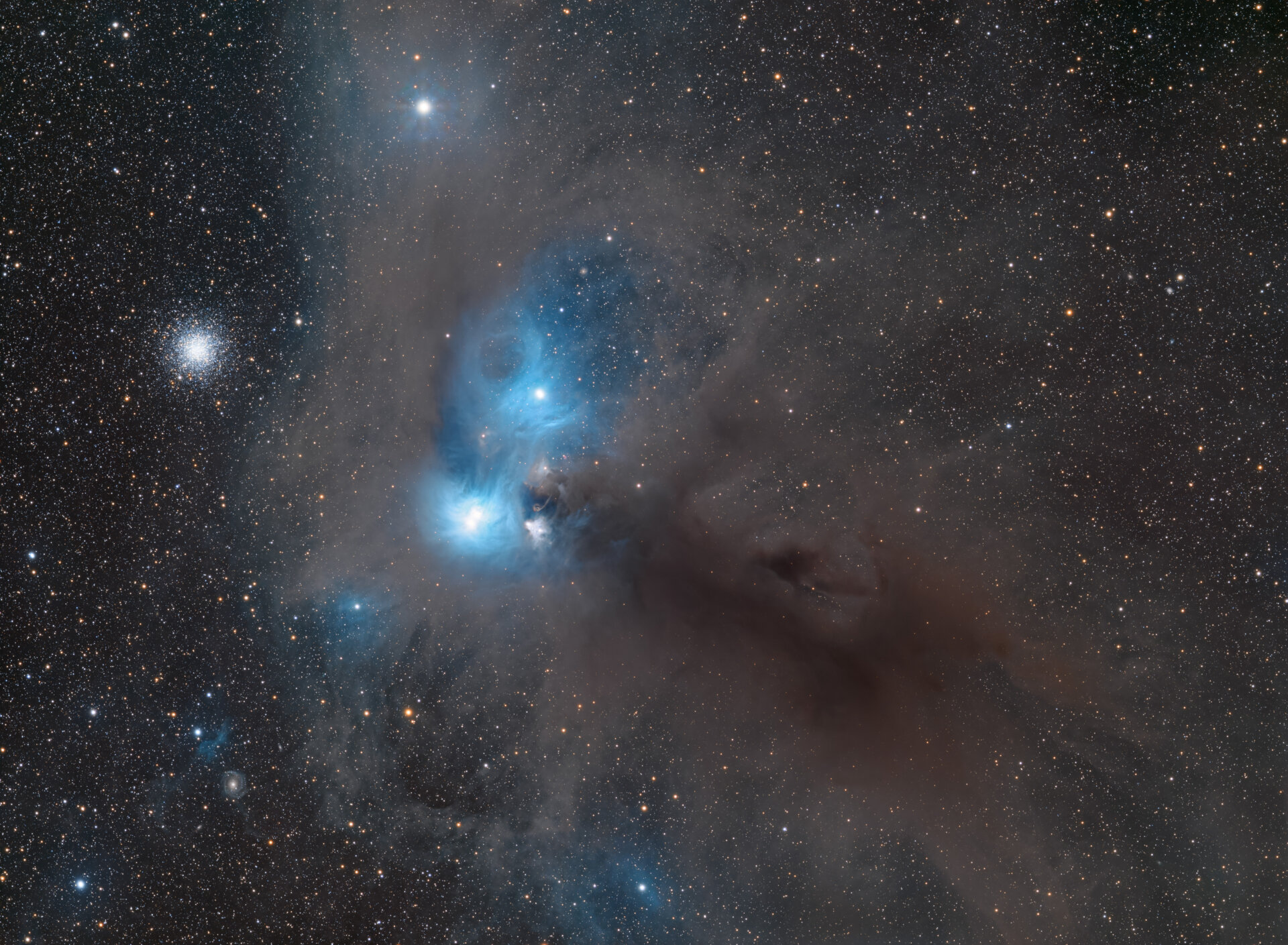
I was able to get a lot of imaging time for this object and the result is undoubtedly my best DSO so far. There's loads going on in this image, and I had a great time researching some of the most prominent objects visible.
NGC 6727 is a region of nebulosity within the Corona Australis molecular cloud. Within the bright centre there are multiple reflection nebulae surrounding 4 bright, young stars that have formed within this region, as well as numerous sites of active star formation including Herberg-Haro objects, Young Stellar Objects, and the Coronet Cluster. This is one of the closest star-forming regions to our solar system at just 130 Pc (430 Light-years), around 3.5x nearer than the much more famous Orion Nebula.
To the left of the image is the Chandelier Globular Cluster here (NGC 6723). Despite appearing “next to” NGC 6729, it is roughly 70x further away at a distance of 8.7 Kpc (28,000 light-years). With an estimated age of just over 13 billion years, it is one of the oldest star clusters in the Milky Way, however it is clearly visible that many of the stars are blue and white, rather than more orange colours that indicate older populations of stars. This is because this star cluster has an unusually high metallicity, with only 0.4% of the stars coming from the primordial population.
In the bottom left we find the face-on spiral galaxy PGC62700, which is classified as an Sb diffuse galaxy. It has a redshift of 0.0178, corresponding to a luminosity distance of around 78 Mpc (250 Million light-years), and the supermassive black hole within is a candidate for an active galactic nucleus (AGN)